
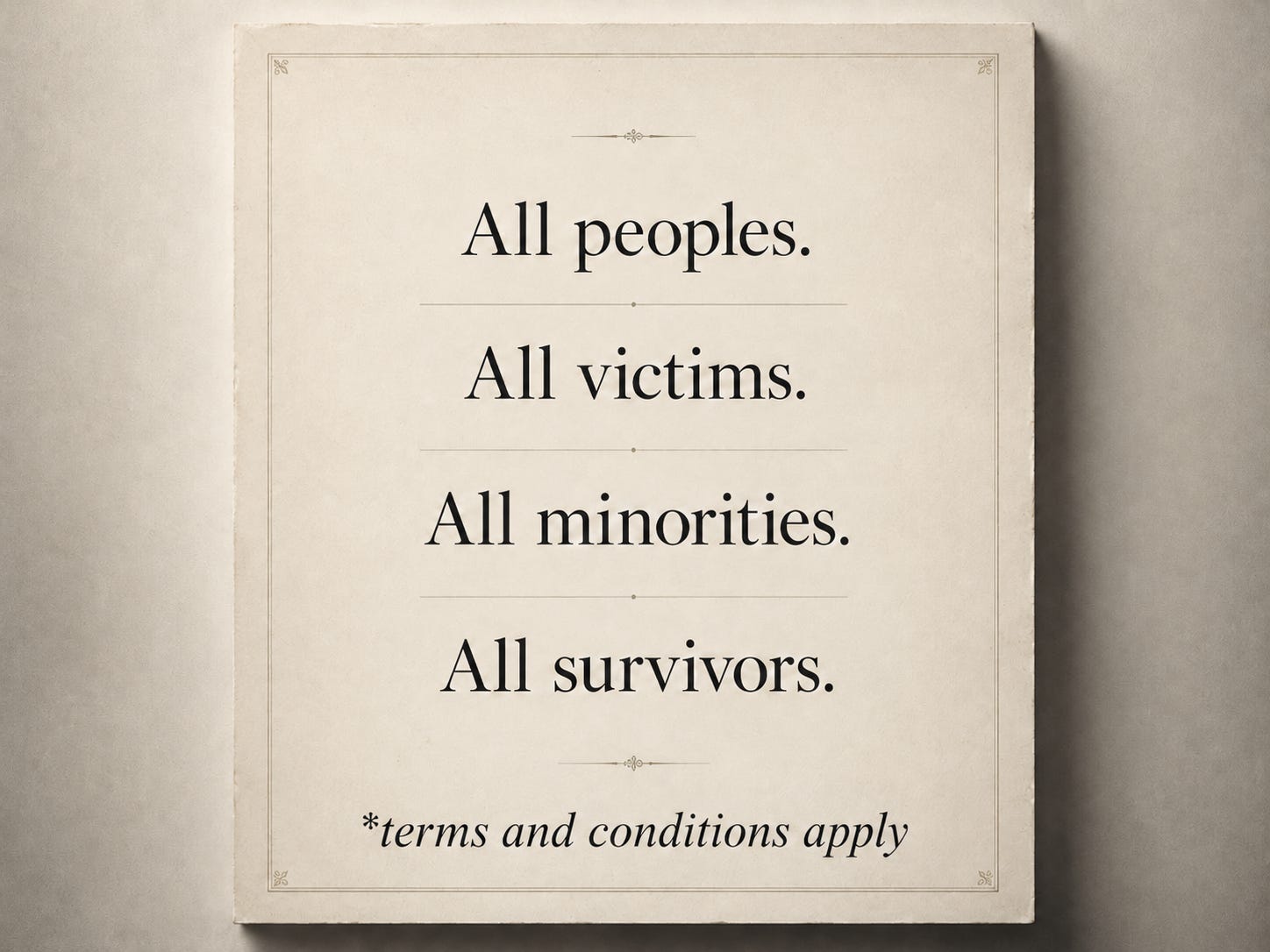
When Progressive Principles Come with an Asterisk.
The current wave of progressive antisemitism is not only an attack on Jews, but a betrayal of the most cherished progressive principles.

When Jewish officer Alfred Dreyfuss was falsely accused of treason, he ignited one of the most famous crises in modern French history. France divided itself between Dreyfussards (pro-Dreyfuss) and Anti-Dreyfussards, and the drama lasted for years, until Dreyfuss was cleared and rehabilitated.
The role of intellectuals in that heated time is well-known. Emile Zola’s famous piece “J’accuse…!” became a template for denouncing injustice, discrimination, and state-sponsored lies. Less known today is another Dreyfussard thinker, Julien Benda. His insight, however, may be more relevant for our times.
Benda’s main concern wasn’t public opinion or corrupt political leaders but his fellow intellectuals: writers, scholars, and moralists who claimed to serve truth, but instead allowed their ideas to become servants of faction, passion, and prejudice.
In his most important book, called The Treason of the Intellectuals, Benda shows how intellectuals claim to believe in universal principles, but then betray those principles in the service of political agendas, bigotry, and xenophobia. His most devastating quote is “Our age is indeed the age of the intellectual organization of political hatreds.”
Benda was an anti-nationalist because he believed nationalist passions tempted intellectuals to bend universal principles. He was not, therefore, an easy ally of Zionism (or Palestinian nationalism). But that is precisely why he is useful. Benda’s demand was consistency. If one claims to believe in a universal principle, one cannot suspend it the moment it becomes inconvenient to one’s political or ideological agenda.
We can analyze contemporary progressive antizionism in light of Benda’s demand. Anti-Israel activists have probably never heard of Benda, but they often denounce progressive Zionists using a version of his argument. They have coined the phrase “progressive except for Palestine” to describe Jews and others whom they accuse of hypocrisy. The phrase is used not merely to criticize them, but often to exclude them from progressive spaces altogether.
The issue is not that progressives criticize Israel, but that principles advertised as universal — believe victims, reject collective blame, honor lived experience, judge speech by impact, oppose dehumanization, respect self-determination — are applied passionately in every case except the Jewish one. As with much contemporary pseudo-progressivism, however, every accusation is a confession. The real problem is often the reverse. It is not Jews who abandon progressive values when Israel enters the conversation. It is frequently anti-Zionist progressives who bend or break their own principles in the service of intolerance.
To see this clearly, let us examine how some progressives violate their own principles when the subject is Israel and the Jews.
1. “Impact matters more than intent” — except when Jews describe antisemitic impact
In antiracist and DEI discourse, a core idea is that harm can be real even if it was unintended. Derald Wing Sue’s influential work on microaggressions defines them as everyday indignities that may be “intentional or unintentional” but still communicate hostile or derogatory messages toward minority groups. But when Jews say that phrases like “globalize the intifada,” Holocaust inversions, “Zionists control X,” or social exclusion of “Zionists” have an antisemitic impact, the answer often becomes: You are misunderstanding our intent. Suddenly, intent is sovereign again.
For every other minority, impact reveals harm. For Jews, intent absolves it.
2. “Believe marginalized people about their own experience” — except Jews on antisemitism
Progressive discourse often insists that outsiders should not be the final judges of a minority’s pain. But with Jews, the pattern is different: Jewish testimony is treated as special pleading, bad faith, hasbara, fragility, or an attempt to silence criticism.
David Hirsh calls this “The Livingstone Formulation,” after antisemitic former mayor of London Ken Livingstone: instead of engaging the substance of an antisemitism claim, the respondent accuses the Jew of making the claim dishonestly to suppress criticism of Israel. So the accusation is flipped. Thus, the Jew who names antisemitism is not heard as a witness, but prosecuted as a censor.
There’s even a deeper violation here. Progressives usually say that affected communities should have a major voice in defining the harm done to them. But when Jews define certain rhetoric, exclusions, or conspiracy tropes as antisemitic, they are often told that they are exaggerating, weaponizing trauma, or acting in bad faith. Jews are invited to testify about antisemitism only after agreeing not to define it.
This is not merely theoretical. In New York City, where antisemitic incidents have risen sharply in recent years, political leaders who refuse to adopt the IHRA definition of antisemitism — or any serious working definition — are effectively claiming the authority to fight a phenomenon they decline to define. Worse, they are saying that they, and not Jews, will decide what counts as antisemitism. Progressives would not accept that arrangement for any other minority.
3. “Do not hold minorities collectively responsible” — except Jews
After 9/11, progressives rightly argued that Muslims should not be forced to apologize for terrorism. Asian Americans should not answer for China. Russians abroad should not answer for Putin. Palestinians should not be reduced to Hamas.
But Jews on campuses, in cultural institutions, and in progressive spaces are often treated as morally suspect. This is not only politically ugly; it is bigoted.
While progressives usually reject the demand that Muslims condemn terrorism every time there is an attack, Jews are often expected to denounce Israel before being allowed into moral conversation.
In other words, the collective-blame taboo is universal — until the collective is Jewish. Litmus tests are abhorrent, but they are demanded of Jews as a matter of course.
Broadly speaking, it is anathema for progressives to demand that minorities renounce to parts of themselves as the price of admission. They coined the term “bring your full self” to the public space. But Jews are often asked to pass a test: Are you a “good Jew” who repudiates Zionism, or a suspect Jew who must be monitored? The price of admission to some progressive spaces is that Jews amputate the part of their identity that connects them to Jewish peoplehood.
4. “Power does not erase vulnerability” — except Jewish vulnerability
Progressives usually understand that a group can be socially or economically successful and still be vulnerable. Asians can be called “model minorities” and still face racism. Gay people can be affluent and still face homophobia. Women can hold power and still face misogyny.
But Jews are often placed in the category of “power” so completely that Jewish fear becomes illegitimate. This is where crude oppressor/oppressed binaries meet antisemitism. They both imagine Jews as all-powerful, conspiratorial, manipulative, wealthy, or secretly controlling things.
Antisemitism is the only form of racism that disguises itself as anti-power.
5. “National self-determination matters” — except Jewish self-determination
International law and progressive politics both recognize that peoples have a right to collective self-determination. Article 1 of the major human-rights covenants begins with the principle that “all peoples have the right of self-determination.” Indigenous rights frameworks also emphasize collective self-determination; UNDRIP Article 3 states that Indigenous peoples have the right to determine their political status and pursue their development.
But Jewish peoplehood is often recoded as merely religious. If Jews are only a religion, then Zionism can be dismissed as a bizarre demand for a “religious state.” But Jews are also an indigenous people, a civilization, a language-bearing, memory-bearing, land-linked collective. One can argue about borders, settlements, occupation, Palestinian rights, or the character of the Israeli state. But denying that Jews have any legitimate collective claim at all is not ordinary criticism.
The Jewish people are treated as too ancient to be modern and too successful to be indigenous.
There is something even more pernicious at play here. For progressives, Identity is complex and self-defined, except for Jewish identity
People are generally allowed to describe themselves as a people, a culture, a religion, a civilization, a nation, or some mixture of these. Jews, however, are often flattened into “just a religion,” because that makes Jewish peoplehood and Zionism easier to dismiss.
The same culture that celebrates fluid, layered identity demands that Jews become only a denomination.
6. “Context matters” — except Jewish historical context
Progressive analysis is usually contextual. It asks: What is the history? What trauma does this symbol evoke? What power does this word carry? What past violence does this rhetoric summon?
But when Jewish history enters the picture, context is often flattened. Calls to boycott “Zionists” willfully ignore the historical echoes such boycotts carry for Jews. Comparisons between Israelis and Nazis are not only cruel and false; they also violate a key progressive tenet. An ideology exquisitely sensitive to traumatic symbols in every other case becomes strangely careless with Jewish trauma.
Progressives are usually serious about the way past violence shapes present vulnerability. But Jewish trauma is frequently treated as manipulation. The Holocaust, exile, pogroms, and antisemitism are cast as excuses rather than wounds.
Every people is allowed a memory, except Jews, whose memory is treated as propaganda.
7. “Don’t tokenize minorities” — except anti-Zionist Jews
Progressive spaces are usually alert to tokenism. One Black person does not speak for all Black people; one Muslim does not invalidate Islamophobia; one woman does not erase misogyny.
But a small number of anti-Zionist Jews are often used as moral absolution: See, Jews agree with us.
The Jewish dissenter is not treated as one voice among many, but as a permission slip.
8. Beware essentialism — except Zionists
Progressive language usually warns against reducing people to one identity. But “Zionist” is often used not as a political description but as a totalizing moral category: corrupt, colonial, racist, dangerous, beyond conversation. Since most Jews have some connection to Israel, this often becomes a way of condemning Jews without saying “Jews.”
‘Zionist’ becomes the word that lets people essentialize Jews while congratulating themselves for avoiding the word Jew.”
This correlates with another violation of the progressive doctrine: dehumanization. Progressive politics usually insists that even guilty people must not be stripped of their humanity. But Israelis are often spoken of as settlers, colonizers, soldiers, occupiers, Zionists — rarely as children, parents, leftists, refugees, Mizrahim, Holocaust descendants, peace activists, hostages, or ordinary human beings.
Boycotts are not only a mechanism of exclusion. At their worst, they become a statement that there is no human being in front of me who deserves to be seen as a person.
9. “Safety matters” — except Jewish safety
Safe spaces, emotional harm, exclusionary speech, and hostile climates are key concepts in the progressive worldview. But when Jews say that certain chants, imagery, academic boycotts, or social litmus tests make Jews unsafe, they are told they are confusing discomfort with danger.
For any other minority, safety is subjective. It’s they who define what harms them. But when Jews say they feel unsafe, then it becomes a courtroom standard.
10 – “Believe women, believe survivors,” – except Jewish ones.
There’s a hitherto unbreakable progressive principle: Survivors of sexual violence should not be met first with suspicion, forensic nitpicking, or ideological dismissal. But after October 7th, Israeli Jewish women were treated as if their testimony, their bodies, and even corroborating evidence had to overcome a political presumption of bad faith.
For every other victim, disbelief is rape culture. For Israeli Jewish women, disbelief became political sophistication.
--
Like Benda, I’m not asking progressives to abandon their principles – whether I agree with them or not would be a different conversation – I demand that they apply them consistently, without an asterisk that says “except for Jews.”
Again, the unacceptable thing is not that progressives criticize Israel. Israel is a state, and states should be criticized. What’s unacceptable is that, when Jews or Israel enter the conversation, many of the progressive world’s most cherished moral rules suddenly become negotiable.
Speech is usually judged by impact, not intent — until Jews say that certain slogans, analogies, or exclusions make them feel unsafe. Then intent becomes everything: “That’s not what we meant.” Lived experience is usually treated as morally serious — until Jews describe antisemitism, at which point they are told they are misreading (or weaponizing) their own oppression. Collective blame is usually condemned — unless Jews are made to answer for Israel. National self-determination is usually honored — unless the nation in question is the Jewish people.
Antisemitism is always suicidal. When antisemitism hijacks the human-rights ecosystem, it does not harm only Jews. It destroys the credibility of the institutions and movements that allow it to enter. As a result, victims of abuse around the world are left with fewer credible advocates. Paradoxically, this also harms Palestinians, because the demonization of Israel and Zionism makes it easier for many people to dismiss real instances of Israeli abuse.
That may be the worst consequence of progressive inconsistency: it not only harms Jews. It discredits progressive values themselves. The next time progressives speak about sexual violence, their denial or minimization of Hamas’s sexual violence will be used against them. The next time they call attention to the vulnerability of minorities, their indifference to Jewish vulnerability will weaken the claim. The next time they accuse others of racism, their own hypocrisy will be used to dismiss the charge.
Of course, plenty of Jews also suspend their principles when it comes to Palestinians. To say that Jews have the right to self-determination and Palestinians do not is the same inconsistency I am critiquing here. But two wrongs do not make a right. Progressives cannot use the inconsistency of some Jews as a license to exclude Jews from universal principles. That, too, violates the very values they claim to uphold.
Here’s the reality that we need to see: a principle that disappears when Jews need it was never a principle. It was a permission structure for bigotry.
Thank you. I genuinely feel like I'm losing my mind.
OOF! Nailed it!!!
"Antisemitism is the only form of racism that disguises itself as anti-power."
And I think it's why all 10 of your principles get suspended for Jews. Antisemitism doesn't trip the progressive detector system because it looks like 'speaking truth to power'. We are cast as the hidden, wealthy, global elite pulling the puppet strings and that's not a minority to protect, it's the thing that needs to be brought down.
I just published a piece on why antisemitism, conspiracy thinking, and populism tend to travel together and I think we're pointing at the same problem from different perspectives.
I'd love to hear your thoughts:
https://kaylaspeaksout.substack.com/p/why-do-populism-conspiracy-thinking